The Hard Part of Selling Simplicity
Fintech · Product Positioning · GTM · User Acquisition
An independent acquisition strategy for Fold Money
The opportunity
Fold Money is an Indian personal finance management (PFM) platform built on the Account Aggregator ecosystem. It consolidates financial data across accounts and automates expense tracking, giving users a unified view of their finances.
A tweet from Fold in March 2025 sent me down a rabbit hole. The product was interesting, but what caught my attention was the acquisition challenge behind it.
India's open-finance infrastructure was expanding, but consumers still needed to understand the value of consent-based financial data sharing.
A 2024 CGAP–Sahamati survey found that over 25% of surveyed smartphone users had used consent-based sharing with PFM applications. Awareness of Account Aggregators, however, remained limited outside certain financial use cases.
My hypothesis: Fold's acquisition opportunity wasn't simply selling better financial tracking. It was making the value of automated financial visibility obvious before asking users to connect their accounts.
After all, a product designed to simplify your finances shouldn't require a finance lesson just to understand why you need it.
Everything Folds was my proposed approach to that challenge.
Project disclosure: This is an independent, unsolicited concept inspired by a Fold Money tweet. I was not affiliated with the company. None of the proposed campaigns were commissioned, executed or tested. The market evidence referenced here supplements the original creative proposal.
01 / Positioning: Lead with the job to be done
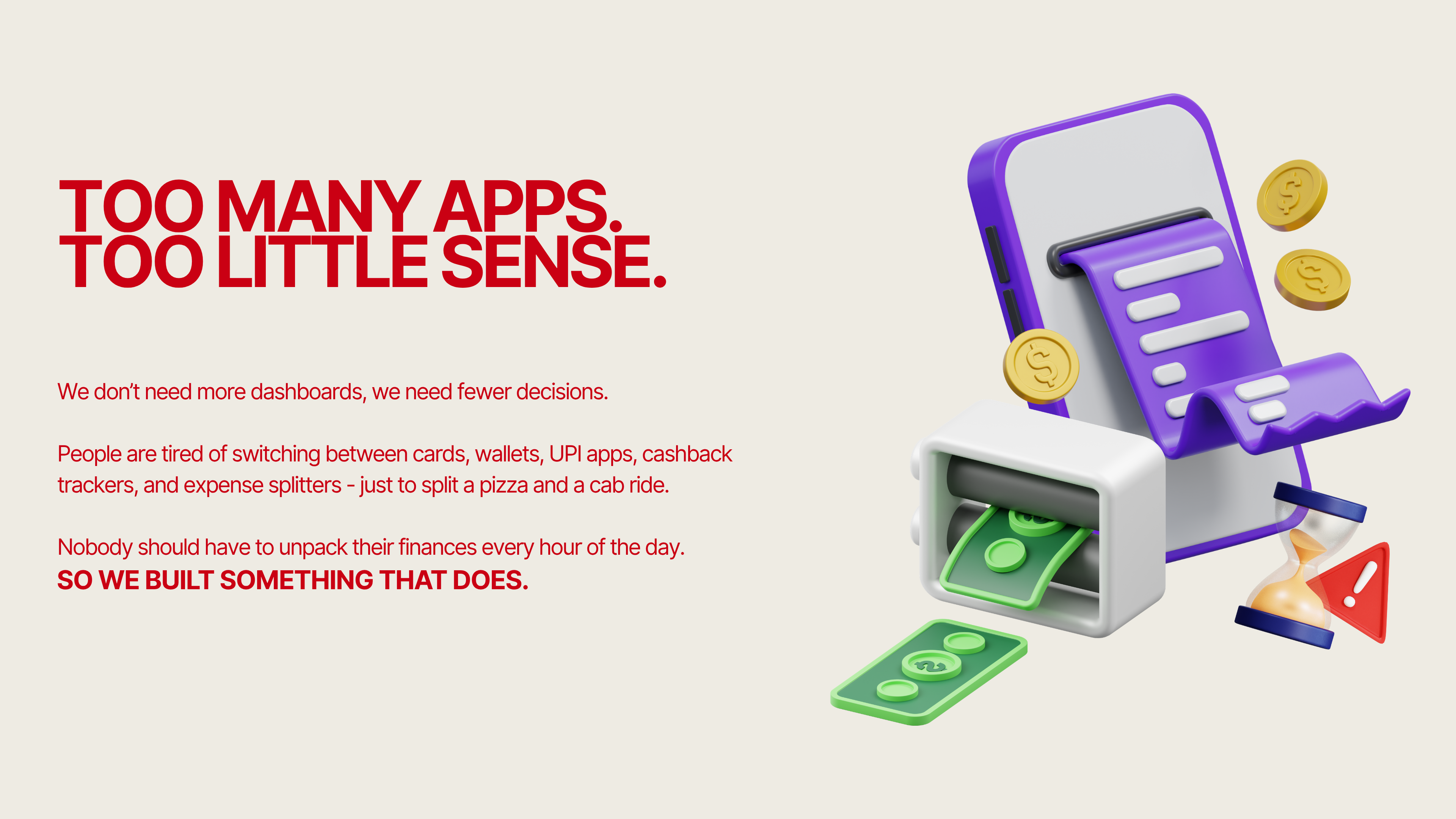
Fold addresses a familiar problem: financial information distributed across different services, requiring effort to consolidate and interpret.
Its functional differentiation lies in automated aggregation and transaction visibility.
I translated that into a benefit-led proposition: one place for the information, less effort to make sense of it.
The creative hypothesis was that reducing perceived effort would be a more immediate acquisition hook than explaining the underlying technology.
The infrastructure might be sophisticated. The first interaction with the product shouldn't have to be.
02 / Audience strategy: Find the adoption opportunity
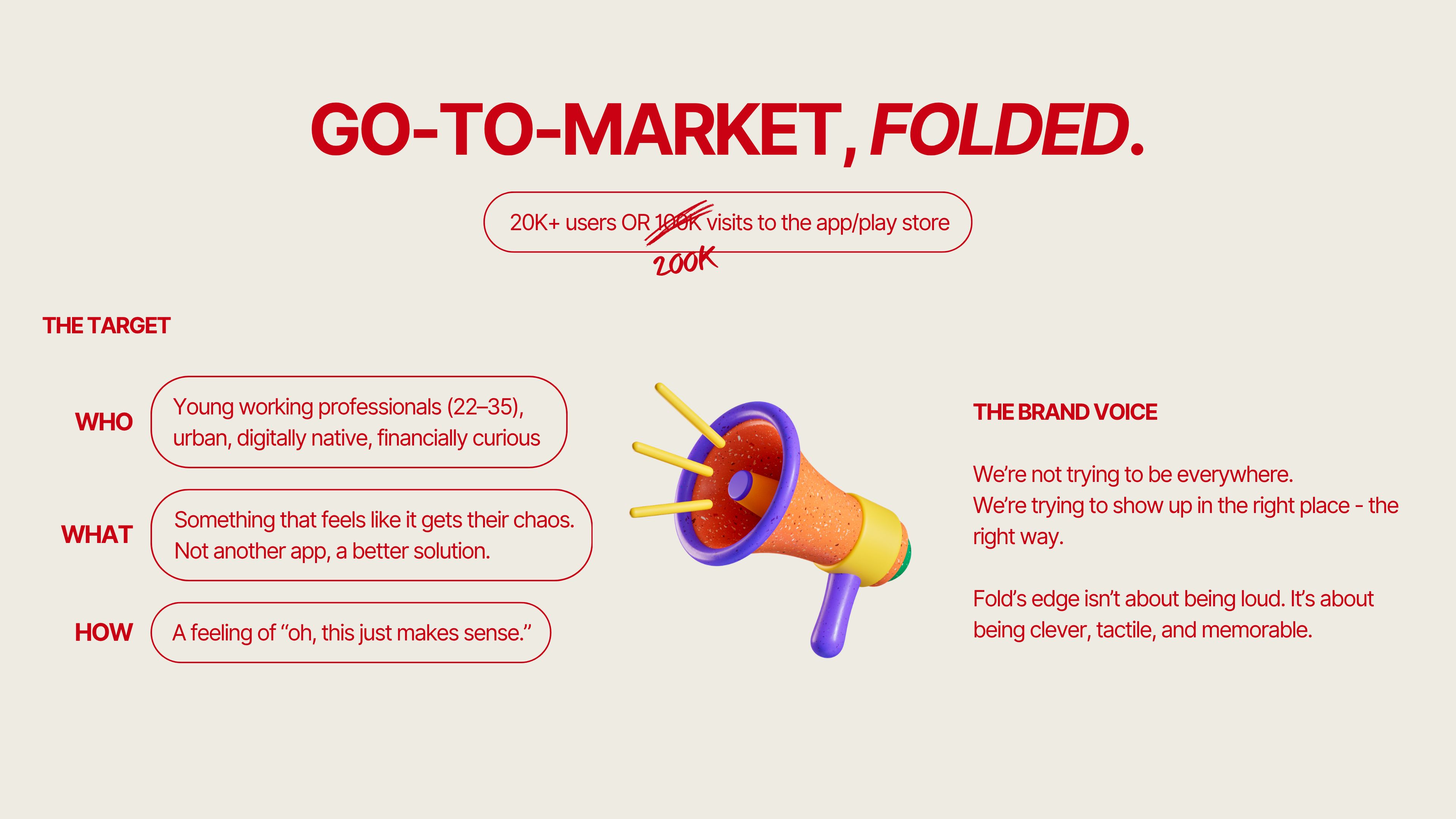
I prioritised digitally native working professionals aged 22–35 as an initial audience hypothesis, based on their likely familiarity with digital payments and multiple financial services.
The objective was to reach consumers who already had relevant financial behaviours but hadn't necessarily adopted a dedicated PFM product.
The proposed acquisition journey had three jobs: establish problem recognition, communicate differentiated value and build confidence to try the product.
The figures in the pitch were proposed targets, not results.
03 / Creator-led acquisition: Reach beyond finance enthusiasts
Finance doesn't exist independently of everyday life. It influences spending, travel, food, shopping and practically every routine we have.
Which is why I found lifestyle creators a more interesting starting point than another round of finance explainers.
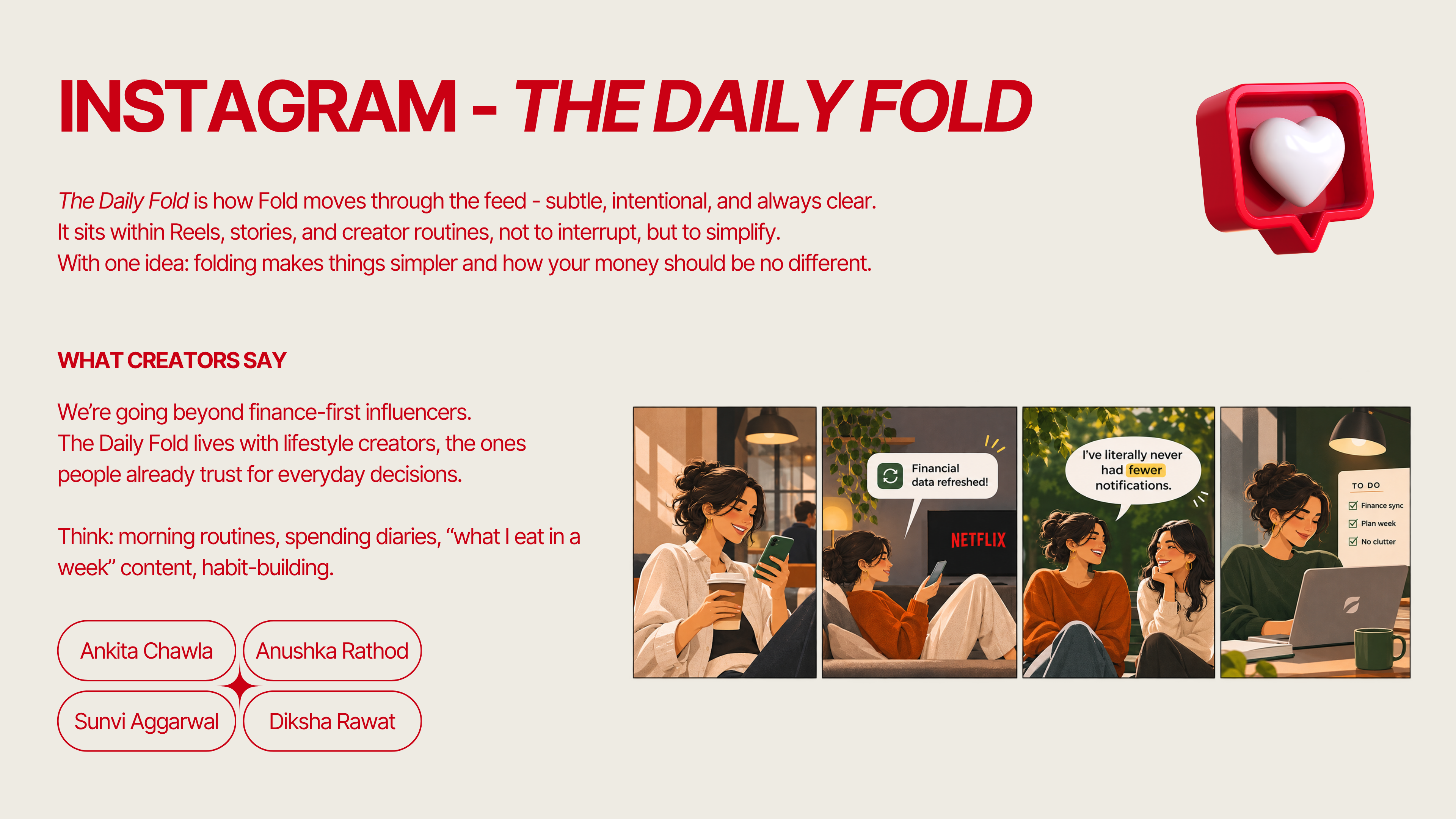
The Daily Fold explored lifestyle creators as a discovery channel for users who wouldn't ordinarily engage with personal finance content.
Spending diaries, everyday routines and purchasing decisions provided natural contexts for demonstrating Fold's use case.
The hypothesis was that familiar situations could create stronger initial relevance than finance-specific messaging alone.
I'd validate the channel through qualified traffic, install conversion and activation before committing to scale.
04 / Product-led storytelling: Demonstrate the outcome
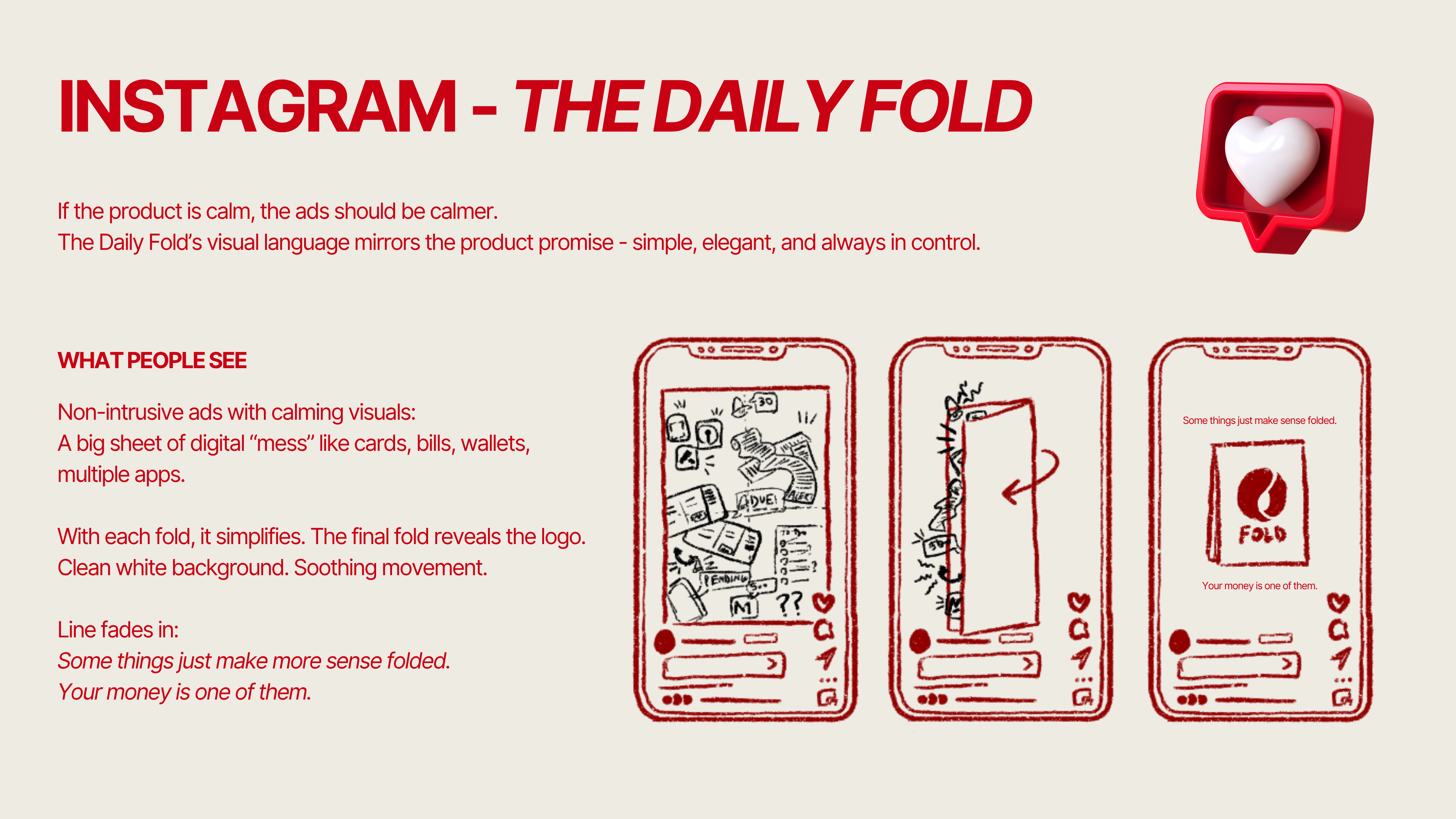
The advertising system visualised fragmented financial information folding into one organised view.
This was a deliberate creative translation of the product's core utility: consolidation without the manual effort.
Rather than lead with integrations or technical architecture, the concept demonstrates the outcome a user receives.
The intended role was to improve value-proposition comprehension and motivate product exploration.
Sometimes the clearest product demonstration is the one that barely needs explaining.
05 / Experiential acquisition: Make the message memorable
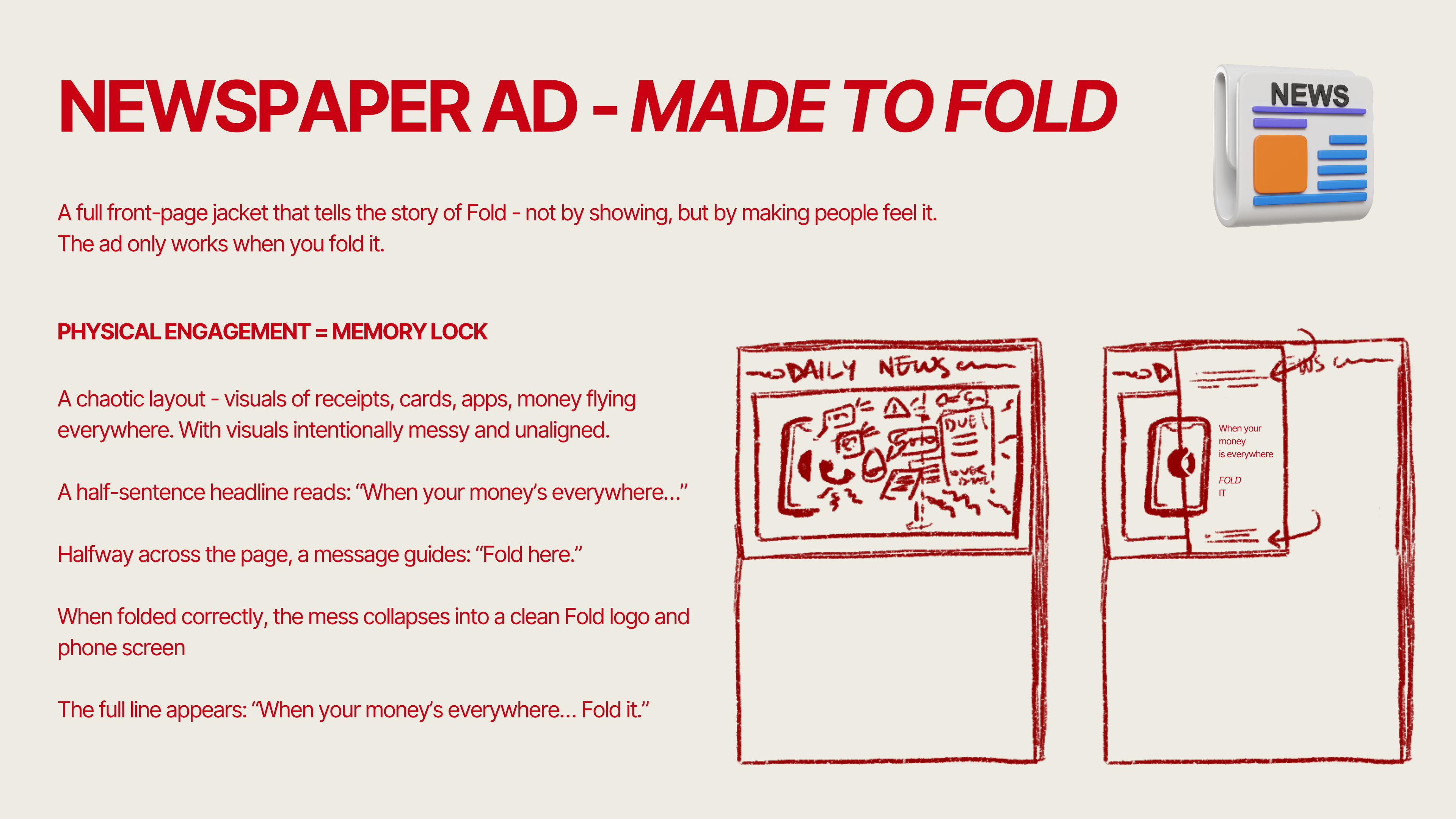
The newspaper concept translated the same proposition into a physical interaction.
The reader folds a chaotic advertisement to reveal a simplified message.
I liked the idea of making the audience do the very thing the brand promised. The fold itself becomes the pitch.
I saw this primarily as a brand-recall opportunity, with the potential to drive measurable digital discovery through a dedicated landing page or trackable QR code.
It wasn't intended to replace performance acquisition; it would extend the central positioning into a different context.
06 / Community: Address the trust barrier
Financial-data access introduces a different conversion challenge from conventional consumer applications.
Users need to understand what they're consenting to, what information is accessed and how they retain control.
I proposed transparent participation in relevant Reddit communities, prioritising product education and useful responses over promotional acquisition.
The channel's role would be to support informed consideration and help reduce uncertainty around account linking.
Trust isn't something a clever campaign can manufacture. But a thoughtful acquisition strategy should know where it needs to be earned.
07 / Video: Make the product benefit immediate
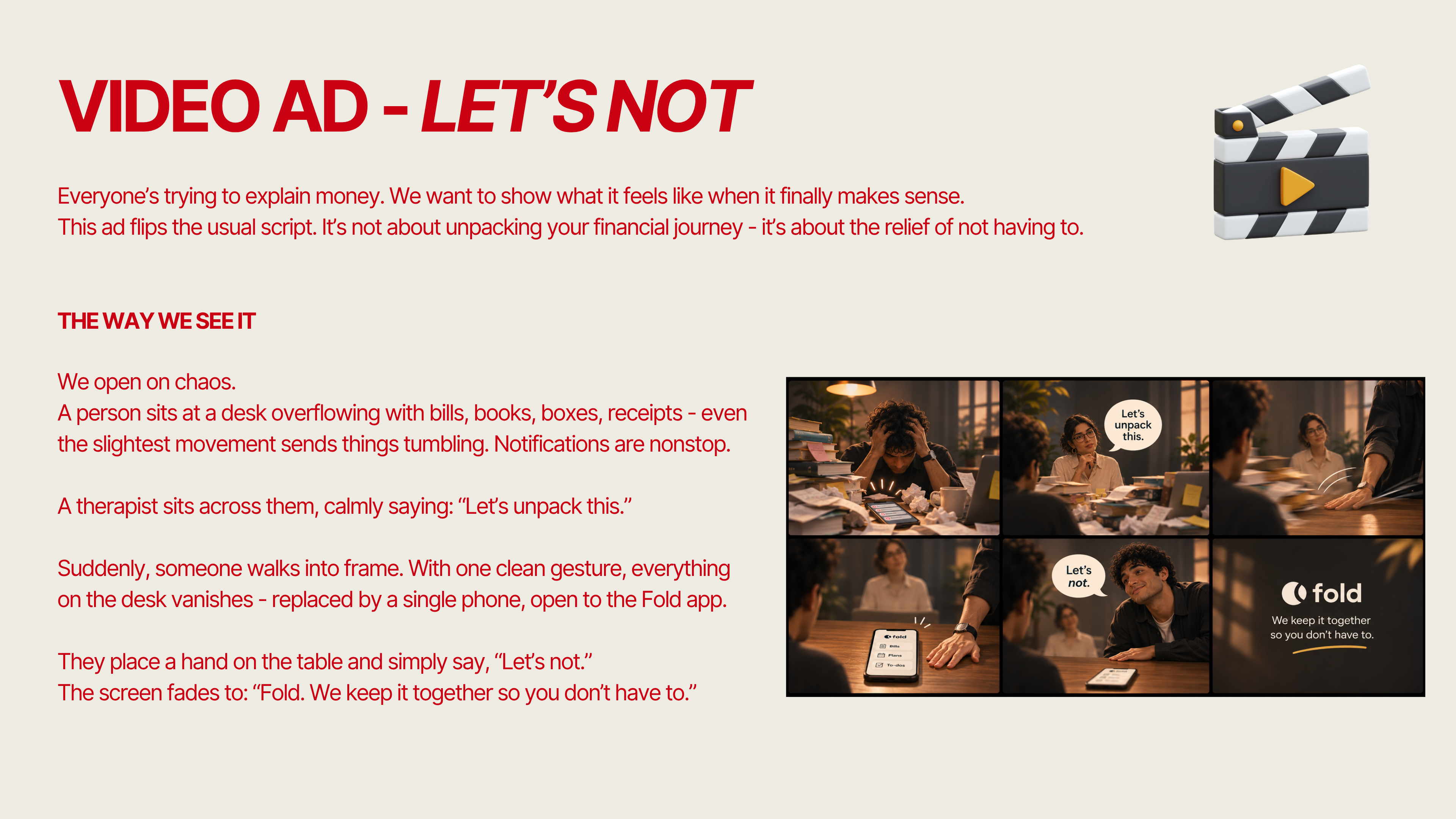
The film takes the emotional cost of fragmented financial management and turns it into a simple product demonstration.
An overwhelmed person sits behind a mountain of bills, receipts and notifications. Their therapist suggests, “Let's unpack this.”
A third person enters, clears everything into a single phone displaying Fold and replies, “Let's not.”
The execution connects the emotional problem with the functional benefit.
The product isn't the joke. The unnecessary effort is.
How I'd measure the strategy
The proposed funnel was:
Relevant discovery → Product consideration → App installation → Account-linking activation → Repeat usage
I'd evaluate the work through channel-level install conversion, account-linking completion, time to first useful financial insight and D7/D30 retention.
The central question wouldn't be which creative generated the most attention. It would be which message brought in users who understood Fold's value well enough to activate and return.
These are proposed success measures; the campaign has no actual performance data.
The takeaway
Everything Folds was an exercise in connecting an emerging fintech capability with a recognisable consumer need.
The strategic challenge was translating account aggregation and automated financial tracking into a proposition that could support discovery, understanding, trust and adoption.
The creative system was how I proposed taking that positioning to market.
Good technology deserves more than a feature list. I wanted to see how far a simple, memorable idea could take it.